 Sabai
Sabai Greetings & Politeness
Play your first phrase
Learn essential Thai greetings and polite particles used every day.
Every line, in the order the app teaches it
23 across 6 lessonsHello & Goodbye
5 linesPlease & Thank You
5 linesHow Are You?
5 linesIntroductions
5 linesYes, No & Replies
5 linesListen & Match
7 linesWork down the page and you are following the same path as the course, lesson by lesson. Press play on any line to hear it.
Worth knowing
ครับ and ค่ะ depend on you, not them
Thai politeness particles go on the end of almost any sentence. Which one you use depends on your own gender, not the person you're speaking to: men commonly use ครับ (khráp); women commonly use ค่ะ (khâ) for statements and คะ (khá) for questions. For example: ขอบคุณค่ะ (khàawp khun khâ), 'Thank you'; สบายดีไหมคะ (sà-baai dii mǎi khá), 'How are you?' The choice follows the speaker, not the listener. Get these forms right and you'll sound polite even when everything else falls apart.
Thai has five tones
The same syllable said at five different pitches is five different words. "Mai" can mean new, wood, burn, not, or turn a sentence into a question. This sounds alarming and isn't - you already do this in English when your voice rises at the end of a question. Thai just uses it on every single word.
Written Thai has no spaces
Words run together with no gaps: สวัสดีครับ is two words. Spaces appear only where English would use a full stop. It looks impossible now, and stops being a problem surprisingly fast - you learn to see word shapes rather than hunt for gaps.
Verbs never change
No I go, he goes, we went. Thai verbs have exactly one form, forever. Time is handed to a small word like แล้ว (already) or จะ (will), and everything else is understood from context. Whole shelves of grammar you had to learn for European languages simply don't exist here.
คุณ works for almost everyone
คุณ (khun) means roughly Mr, Ms and you all at once, and goes in front of a first name - คุณโรบิน, not คุณ plus a surname. Thai people use first names in nearly every situation, formal ones included.
The wai has ranks
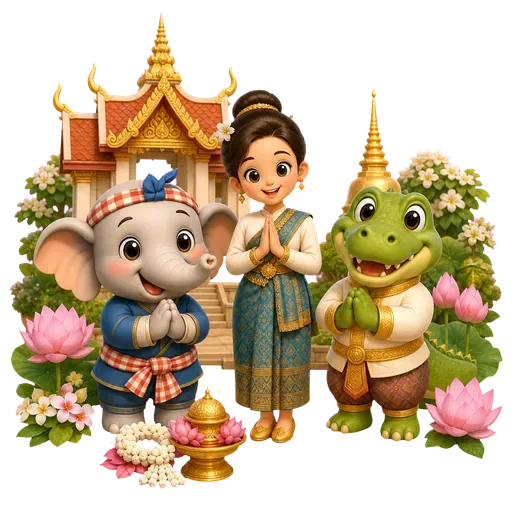
Hands together, but how high matters: fingertips at the chest for friends and colleagues, at the nose for elders, at the brow for monks and royalty. As a visitor you are never expected to get this exactly right, and returning a wai politely is always better than not returning one.
What a phrasebook will not tell you about greetings & politeness
The part that is not vocabulary: who speaks first, what is rude, and what a smile changes.
/thai-culture/chapter-1/
Chapters run in the order you will need them, not in grammatical order. See all 34.

Start learning Thai on Google Play
Start free, with optional Pro. See the course access page for details.
What free includes